What is the difference between 250μm loose buffer cable and 900μm tight buffer cable?

250μm loose tube optical cable and 900μm tight tube optical cable are two different types of optical cables with the same diameter core, cladding and coating. However, there are still differences between the two, which are specifically reflected in the structure, function, advantages, and disadvantages, which also makes the two differences in applications. This article will clarify these two different types of optical cables for you.
Comparison of 250μm loose tube cable and 900μm tight tube cable
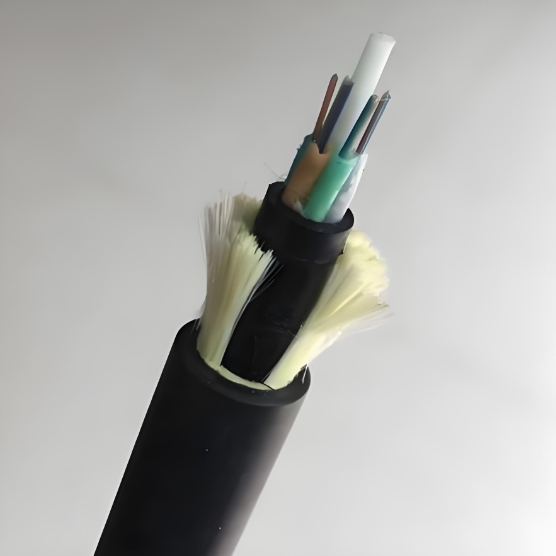
For the loose tube structure of the optical fiber, the optical fiber is helically placed in a semi-rigid tube, so that the cable can be extended without stretching the optical fiber itself. As shown in the figure below, a 250μm loose tube fiber is composed of a core, a 125μm cladding and a 250μm coating. Generally speaking, the number of cores in a 250μm loose tube optical cable is between 6 and 144. Except for 6-core loose tube optical cables, other optical cables are usually constructed with 12 cores as the basic unit.

Different from the above-mentioned loose tube structure, the 900μm tightly buffered fiber has a hard plastic jacket layer added to the 250μm loose tube fiber structure, which can play a protective role. As shown in the figure above, a 900μm tight-buffered fiber is composed of a core, a 125μm cladding, a 250μm coating (the coating is soft plastic) and a jacket (the jacket is hard plastic). Among them, the coating layer and the jacket layer will help isolate the moisture from entering the fiber core, and can prevent the fiber core from being exposed due to bending or compression when the optical cable is laid underwater. The number of cores in a 900μm tight-buffered optical cable is usually between 2 and 144. The tight-buffered optical cable with a larger number of cores is basically composed of 6 cores or 12 cores as the basic unit.
The following specification table shows the specific parameters of 250μm loose tube fiber and 900μm tight tube fiber.
| 250μm loose tube fiber | 900μm tight tube fiber | |
|---|---|---|
| Fiber core | 9μm, single mode; 50μm or 62.5μm, multimode; | 9μm, single mode; 50μm or 62.5μm, multimode; |
| layers | 125μm | 125μm |
| Coating | Soft plastic; 250μm | Soft plastic; 250μm |
| Mantle | —— | Hard plastic, 900μm |
How to choose 250μm loose tube optical cable and 900μm tight tube optical cable?
Due to the different functional characteristics of 250μm loose tube cable and 900μm tight tube cable, the usage conditions of the two are also different, as follows.
| 250μm loose tube optical cable | 900μm tight buffer cable |
|---|---|
|
high density; Low shrinkage and high tensile strength; Mechanical force Moisture-proof Anti-UV; High temperature resistance Flame retardant LSZH polymer; Enhance system performance. |
High flexibility High tensile strength; Good mechanical and temperature performance; Water blocking Anti-UV; Higher standards of survival; Glass fiber reinforced components; End easily. |
250μm loose tube fiber optic cable is suitable for harsh environments and is widely used outdoors. Compared with 900μm tight-buffered fiber optic cable, 250μm loose-buffered fiber optic cable has higher tensile strength, moisture resistance and high temperature resistance, and is suitable for environments with temperature changes and high humidity. However, if it is stretched too much, the core will be pulled out of the gel. In addition, when wiring around multiple bends, 250μm loose tube fiber optic cable may not be a good choice. The following will focus on why 250μm loose tube optical cable is suitable for outdoor environments.
-
Waterproof-by filling the internal structure of the optical cable with gel, the optical cable is protected to the greatest extent, while effectively preventing water penetration.
-
UV protection-The outer sheath contains carbon black, which can effectively prevent UV rays.
-
Mechanical resistance-this type of optical cable has an armored layer, which can withstand greater mechanical force and improve durability.
-
Duct space-It can be seen from the above that the structure of 250μm loose tube fiber optic cable and 900μm tight buffer fiber optic cable is different, and the size of 250μm loose tube fiber optic cable is almost one third of that of 900μm tight tube fiber optic cable. Therefore, compared with 900μm tight buffer fiber optic cable, 250μm The loose tube optical cable occupies less pipe space, especially when the number of optical fibers is large, which can effectively reduce the total installation cost.
The 900μm tight buffer cable is very suitable for indoor applications. Compared with 250μm loose tube fiber optic cable, 900μm tight tube fiber optic cable has stronger characteristics and is more suitable for medium-distance LAN/WAN connection or long-distance indoor laying, or even directly underground laying. The following will focus on why 900μm tight-buffered fiber optic cables are used in indoor environments.
-
No gel required-indoor applications do not require the use of protective gel, so it is more suitable for installation in risers perpendicular to the building.
-
Flexibility-There is no strengthening member, which makes the optical cable more flexible. In addition, it can be pulled around multiple bends or hung vertically without worrying about the movement of the core axis.
-
Easy to splice-Compared with the 250μm loose tube cable, the 900μm tight tube cable is not so fragile, and it is easier to handle each core. There is no need to clean up messy gel, and there is no fan-out kit for splicing or termination, just crimp the connector directly to each fiber.
to sum up
After clarifying the difference in structure and functional characteristics between 250μm loose tube optical cable and 900μm tight buffer optical cable, is it a good way to distinguish the applications of the two? Before installation, be sure to select the appropriate optical cable according to the application environment.
How much do you know about fiber loss? Do you know how to calculate it?
Why Need OM5 Fiber
Related Article